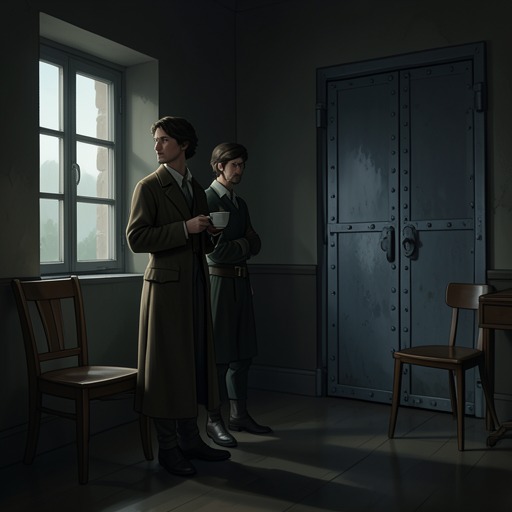
Emma and Ian's final separation
One DayEmma Morley and Ian Whitehead’s final separation is the moment their strained relationship becomes an unmistakable ending. In the narrow hallway of the flat they bought together hopefully, a dispute over whether the home ever made them happy gives way to a more painful truth: Emma cannot renew her love for Ian, and he cannot persuade her to stay. The scene moves from protest and physical restraint to shared grief, then to an answer that neither tenderness nor regret can reverse.
The home and the breaking point
Emma tells Ian that she was never happy in the flat and describes them both as having become stuck there. Her account directly challenges the meaning he has attached to their home: for him, it was theirs; for her, it had become part of a life neither had managed to leave. The disagreement is not simply about the flat’s history. It exposes the distance between a shared investment and a shared sense of belonging.
Ian has never seen Emma behave or speak this way. Shocked, he moves towards her and grips her arm, asking her to calm down and not to say such things. Emma orders him to get away and insists that she means it. As they shout, she imagines how the scene would sound to someone listening through the walls, a couple whose argument might prompt a neighbour to wonder whether to call the police. That inward glance makes the conflict feel both intensely private and suddenly public: the relationship has reached a point where their own home could make them seem like strangers in crisis.
The argument becomes an immediate demand for separation. Emma tells Ian to give her his keys and leave, saying she does not want to see him any more. Yet the scene does not proceed in a straight line from anger to departure. Both begin crying and sink to the hallway floor. Ian covers his face and struggles to speak through sobs and gasps; his distress turns the demand to leave into a shared experience of loss, without cancelling the demand itself.
Love, regret, and refusal
On the floor, Ian asks why Emma cannot love him and whether she had once been in love with him. Emma confirms that she had. His question makes the past part of the immediate dispute: the relationship was real, but its beginning cannot serve as proof that its former feeling can be recovered. When he asks why she cannot fall in love with him again, she answers that she has tried and cannot. Her apology acknowledges his pain while leaving no opening for a different decision.
After some time they remain together on the floor, Emma’s head on Ian’s shoulder and her arm across his chest. She takes in the familiar, warm smell of him, a small detail that registers the comfort built by their shared life even as that life ends. The physical closeness is therefore not a reconciliation. Ian eventually says that he should go, and Emma agrees that he should. Their separation is defined by this uncomfortable coexistence of tenderness and refusal: she can hold him and grieve with him, but she will not resume the relationship.
Before leaving, Ian raises the possibility that Emma’s decision is connected to Dexter Mayhew. He has seen reports that Dexter and his girlfriend have split up and wonders whether Emma and Ian’s breakup, coinciding with Dexter being single, means she is seeing him. Emma sighs, shakes her head, and swears that she is not. The exchange makes Ian’s suspicion explicit, but it does not establish an affair or a hidden cause for the separation. Emma’s stated reason remains that she cannot love Ian again.
Ian asks whether she might change her mind. Emma says that she cannot and will not. His attempt to reopen the question ends with a restrained shrug and smile, and the couple exchange goodbyes. The brief, almost comic gesture that follows does not undo the gravity of the parting: Ian pulls the door open sharply and kicks its bottom so it seems to have hit him in the face. Emma laughs dutifully. He takes a deep breath and leaves; she stays on the floor for another minute before standing.
The first steps after the breakup
Emma’s movement away from the flat is abrupt. With renewed purpose, she takes her keys and strides out into a summer evening in E17, amid shouts and screams echoing between the buildings and St George’s flags hanging limply. Her thoughts turn to the kind of circle of eccentric, attractive friends that city life is supposed to provide. The people she might call are either far away or occupied with families and partners. The breakup leaves her without the imagined communal scene of consolation, at least for this evening.
Instead, she heads to the off-licence called Booze’R’Us. Intimidating children cycle in lazy circles near its entrance, but Emma walks through them without fear and chooses the least dubious bottle of wine. While the man ahead of her counts out enough small change for strong cider, she notices champagne behind glass: a dusty relic of a luxury that now seems to belong to an unimaginable past. The scene does not say that she drinks the wine. It shows her moving from the empty flat into an ordinary, solitary errand, carrying the separation into the public spaces of her neighbourhood.
What makes the ending final
The separation’s decisive action is verbal before it is practical. Emma tells Ian to leave, explains that she cannot love him again, denies that Dexter is the reason, and refuses the possibility of changing her mind. These answers close off the different hopes Ian raises in turn: that the home still binds them, that their former love might return, that a rival explains her decision, or that time might reverse it. Her affection remains visible in the embrace and the apology, but it no longer functions as a promise to stay.
The contrast between the purchased flat and the later off-licence gives the parting a concrete shape. The home they acquired with hope becomes the place where Ian must ask to go; outside, Emma finds no ready-made circle of friends waiting to receive her. The dusty champagne behind glass sharpens that change without turning it into a declaration about her future. What the scene establishes is more immediate: the shared household and relationship have ended, Ian has walked out, and Emma has begun moving through the evening alone.